
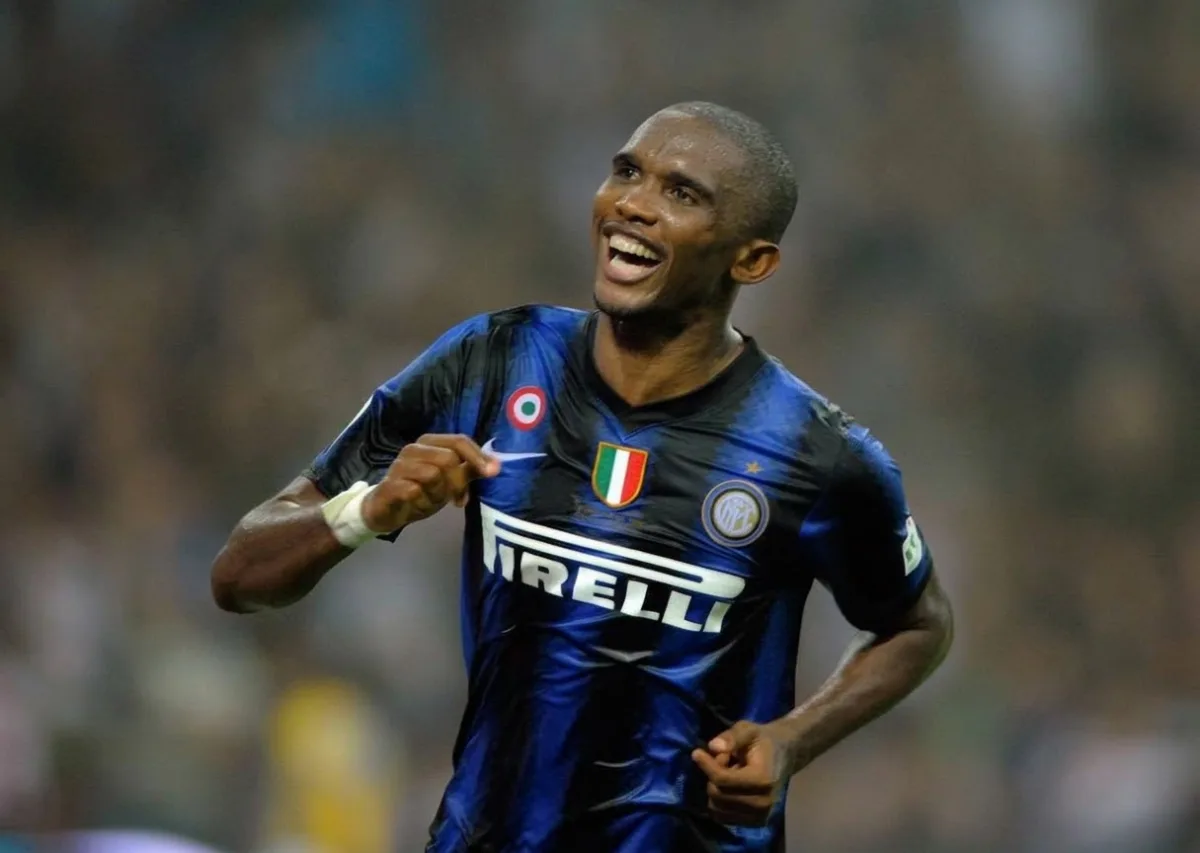
After five successful seasons at FC Barcelona, Samuel Eto’o joined Inter Milan in the summer of 2009, in the headline-making exchange in which Zlatan Ibrahimović went the other way, completed with a payment of 46 million euros to the Catalan club. Although his spell in Lombardy lasted only two seasons, it remained one of the most glorious and most atypical periods of his career.
An unprecedented tactical reinvention under Mourinho
Eto’o arrived at Inter with two Champions League titles won in a Barça shirt and found a role very different from the one he had in Catalonia. José Mourinho placed him on the right wing, where he had to contribute not only in attack but also take an active part in the pressing and the defensive work. The Cameroonian striker accepted this new mission and put himself at the team’s service, above all in the two-legged tie against his former club in the Champions League semi-finals.
His defensive effort was such that Mourinho went as far as describing him, not without admiration, as “one of the best defenders in the world” that night.
This tactical commitment left a deep mark on the nerazzurri dressing room. Far from seeking individual glory, the Cameroonian striker agreed to put himself at the group’s service, a spirit of sacrifice praised by key players such as Javier Zanetti and Diego Milito, and which helped bind together a group that already had a winning mentality.
The historic treble of 2009-2010
Eto’o scored his first Serie A goal from the penalty spot on matchday one against Bari (1-1), and had to wait until the sixth and final matchday of the Champions League group stage to open his European account with Inter, against Rubin Kazan (2-0). But it was above all in the decisive moments that his influence grew greatest. In the Champions League round of 16, he scored the winning goal at Stamford Bridge against Chelsea (1-0), which allowed the nerazzurri to qualify for the quarter-finals.
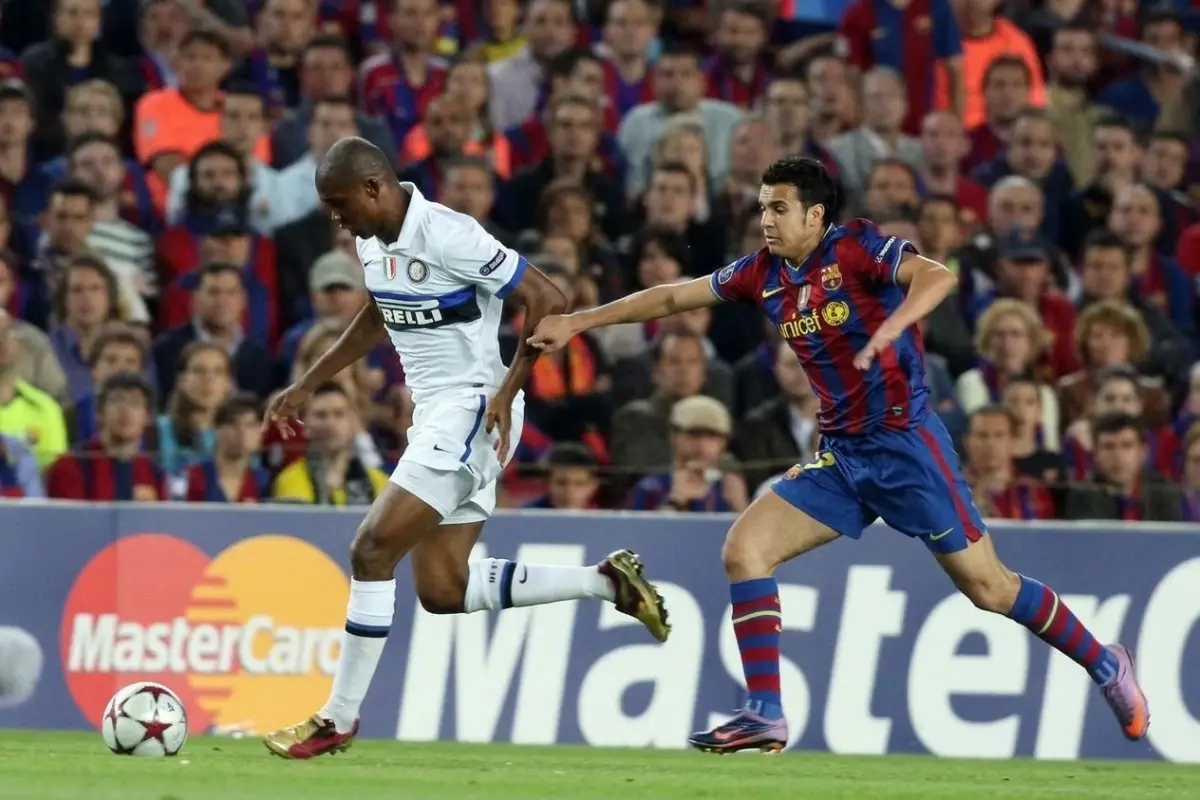
Inter continued their European run to the semi-finals, where Eto’o met his former club, FC Barcelona, again. After a 0-0 draw at San Siro and a 2-0 defeat at the Camp Nou in the group stage, the nerazzurri took their revenge by winning 3-1 in the first leg, on 20 April 2010. Barcelona took the lead with a goal from Pedro, but Sneijder, Maicon and Milito turned the match around. Eto’o, very active in the pressing and the defensive tasks, contributed fully to Inter’s success. In the second leg, on 28 April, Inter lost 1-0 at the Camp Nou with a goal from Piqué, but held on to their advantage thanks to the first-leg win and qualified for the final (3-2 on aggregate). Eto’o thus played in a Champions League final for the third time in five years, after the titles of 2006 and 2009 with Barça.
That first season in Milan ended in the best possible way. Inter won the Scudetto and then the Italian Cup, and sealed a historic treble with the Champions League after beating Bayern Munich 2-0 on 22 May 2010 at the Santiago Bernabéu, with a brace from Diego Milito. Eto’o did not score in the final, but his teamwork and defensive effort were especially valuable in Mourinho’s setup. Above all, he became the first player in history to win the league, national cup and Champions League treble two years in a row with two different clubs, after his success with Barça in 2008-2009.
Years later, Eto’o would also tell an important anecdote about what happened behind the scenes at that final: just before kick-off, Mourinho reportedly handed him the floor in the dressing room to motivate his teammates. The Cameroonian is said to have spoken then about his experience in big finals and the importance of playing for the fans in the stands, a speech that is said to have moved goalkeeper Julio César deeply. That final shows very well Eto’o’s ability to make a difference in the big occasions, even without scoring a goal.
A 2010 finish full of success
After José Mourinho’s departure, Rafael Benítez took charge of Inter in the summer of 2010. From his first official match, Eto’o helped win a new trophy by scoring a brace in the win against AS Roma (3-1) in the Italian Super Cup. A few days later, Inter lost instead to Atlético de Madrid (2-0) in the UEFA Super Cup.
Afterwards, Benítez agreed to move Eto’o closer to his favorite position. The Cameroonian soon recovered his efficiency and became one of the most decisive players in Europe. On 29 September, in particular, he scored his first hat-trick in an Inter shirt against Werder Bremen (4-0), with three goals and an assist for Wesley Sneijder.
At the end of the year, Eto’o already had seven goals in the Champions League and was the competition’s top scorer at the winter break. Inter, after a more uneven first part of the season in Serie A, closed 2010 with another win in the Club World Cup. In the final against TP Mazembe, Eto’o provided an assist for Goran Pandev and then scored the second goal of the victory himself (3-0). A few days earlier, he had been named CAF African Footballer of the Year for the fourth time, after his awards in 2003, 2004 and 2005.
This exceptional year was nevertheless tarnished by a disciplinary incident. On 21 November, in a Serie A match against Chievo Verona, Eto’o headbutted Boštjan Cesar. The gesture, which was not directly punished during the match, later cost him a three-match suspension and a fine of 30,000 euros.
Eto’o fully regains his scoring instinct and leads Inter
The 2010-2011 season quickly confirmed Eto’o’s new version. Wanting to play closer to goal, the Cameroonian gradually regained his nose for goal and became Inter’s main attacking weapon.
After already scoring 15 goals in just 13 matches in the autumn, he kept up that rhythm and finished the season with 41 goals in all competitions, his best tally in a season since arriving in Italy.
Inter nevertheless had a more turbulent season. Benítez left the club in December and Leonardo replaced him, without managing to return the nerazzurri to the throne of Serie A. In the Champions League, Eto’o was decisive again in the round of 16 against Bayern Munich. Beaten 1-0 at home in the first leg, Inter pulled off an incredible comeback in Munich by winning 3-2. Eto’o opened the scoring in the 4th minute and then provided two assists, to Wesley Sneijder and then Goran Pandev, allowing the Italians to qualify thanks to away goals.
However, the European adventure ended in the next round against Schalke 04, while Inter finished second in Serie A. The club finally saved the season by winning the Italian Cup once more: in the final against Palermo (3-1), Eto’o scored two goals and thus lifted another major trophy with the nerazzurri. His time at Inter then took on an even more impressive dimension, as he was one of the main architects of the Milanese club’s golden age.
A surprise move to Anzhi Makhachkala
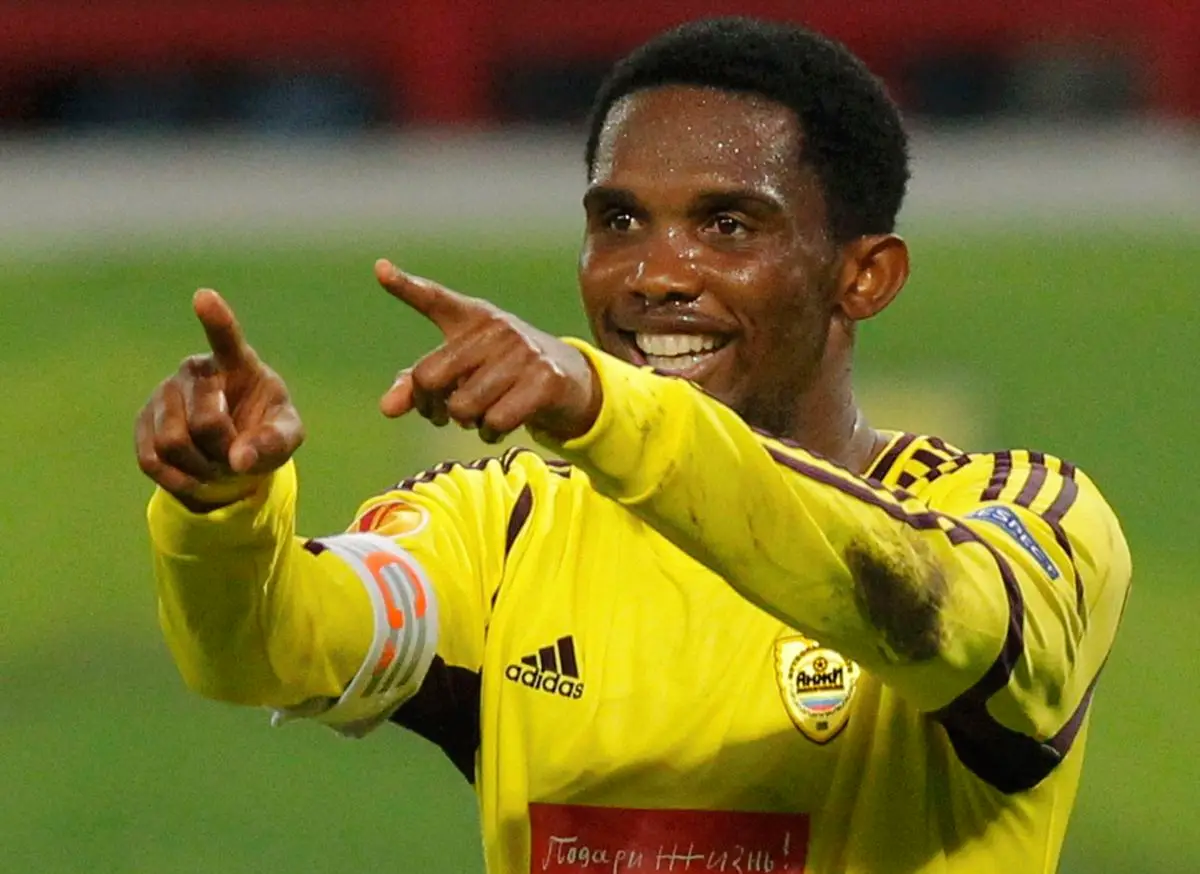
The summer of 2011 brought an unexpected turn in Eto’o’s career. Although he was still under contract at Inter and at the peak of his powers, the Cameroonian striker decided to sign for Anzhi Makhachkala, a modest Russian club from Dagestan owned by billionaire Suleiman Kerimov. The transfer, completed for around 27 million euros, bonuses included, came with an estimated annual salary of more than 20 million euros over 3 years, instantly making Eto’o the highest-paid footballer on the planet, ahead of Lionel Messi and Cristiano Ronaldo. It was a financial decision he openly accepted, one that closed, at 30, the most prestigious chapter of his club career, with three Champions Leagues and a reputation firmly established among the best strikers of his generation.