
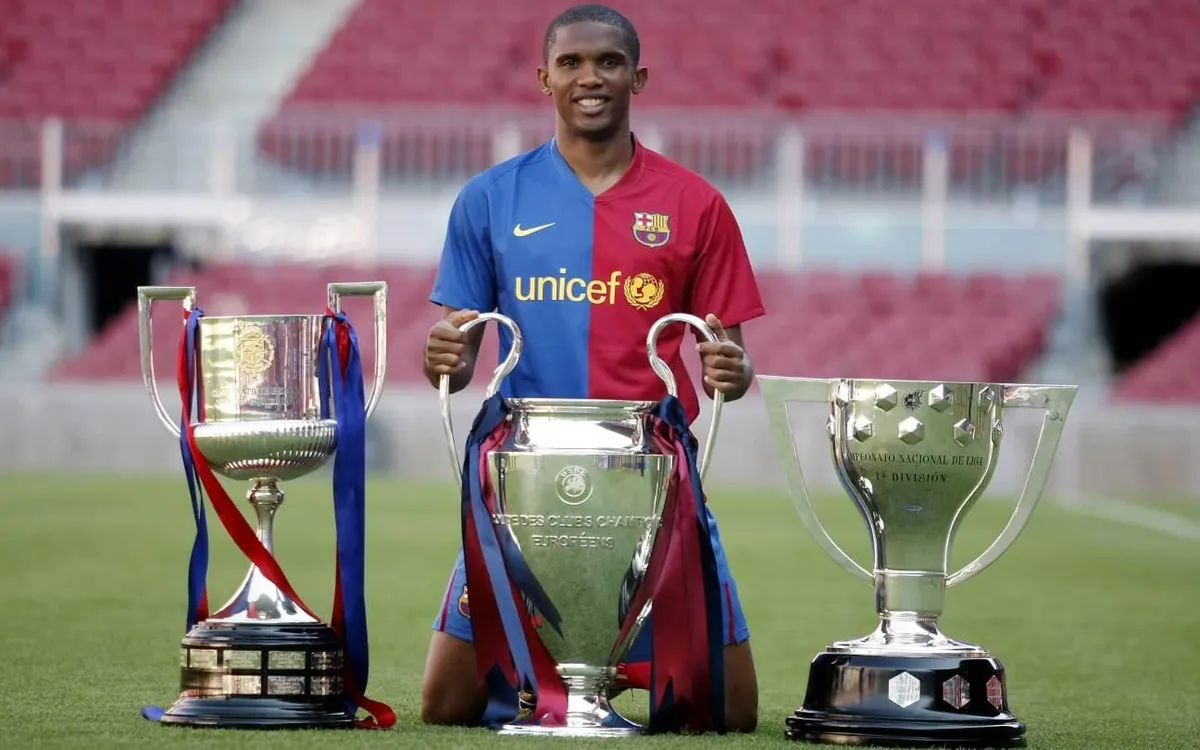
After shining with RCD Mallorca, Samuel Eto’o joined FC Barcelona in the summer of 2004. There he established himself as one of the best strikers of his generation. His five seasons at the Camp Nou were one of the most important stages of his career: he won a great many titles, but he also experienced internal rivalries, tensions and several episodes of racism that left a mark on Spanish football.
A signing after a three-way negotiation
Eto’o’s transfer to Catalonia was not straightforward. Real Madrid, which still held rights over the player from his time at the club, did not want him to move so easily to its great rival.
Florentino Pérez, then president of the Madrid club, reportedly even considered bringing him back to prevent his arrival at FC Barcelona. After several weeks of negotiations between RCD Mallorca, Real Madrid and the Catalan club, an agreement was finally reached in the summer of 2004. Samuel Eto’o then signed with Barça for around 24 million euros, ending a long battle over his signing.
An immediate integration and the first league title
From his first season, 2004-2005, Eto’o was a key piece in FC Barcelona’s renewal. On arrival, he had to compete for a place with Henrik Larsson, who signed at around the same time, but an injury soon slowed the Swedish striker and the Cameroonian was able to settle in as a starter in the attacking trio, alongside Ludovic Giuly and Ronaldinho.
Eto’o also scored in his first La Liga match with Barça, in August 2004 against Racing Santander, and so began his Catalan chapter in the best possible way.
On 20 November 2004, he faced his former club, Real Madrid, again, but this time wearing the shirt of its great rival. As in his years at Mallorca, he was decisive against the Madrid side: he scored a goal in Barça’s 3-0 win at the Santiago Bernabéu. A few weeks later, he was named CAF African Footballer of the Year for the second consecutive time, ahead of, among others, Ivorian Didier Drogba.
After five years without titles, Barça finally won again by taking La Liga. On 14 May 2005, Eto’o scored the equalizer against Levante and allowed the Catalans to officially clinch the title. It was his first league title and Barça’s first after five seasons without a major trophy. That season he finished as the club’s top scorer, with 25 goals in La Liga and 29 in all competitions, which immediately confirmed his importance in the club’s project. He also scored four goals in the Champions League, although the team was eliminated in the round of 16 by Chelsea.
That first year also coincided with the early steps at the highest level of Lionel Messi, a young Argentine prodigy who had just joined the first team. Thus a new generation began to take shape at the Camp Nou, with Eto’o already established as one of the main faces of a team destined to dominate European football in the following years.
The “REM” trio and the peak of 2005-2006
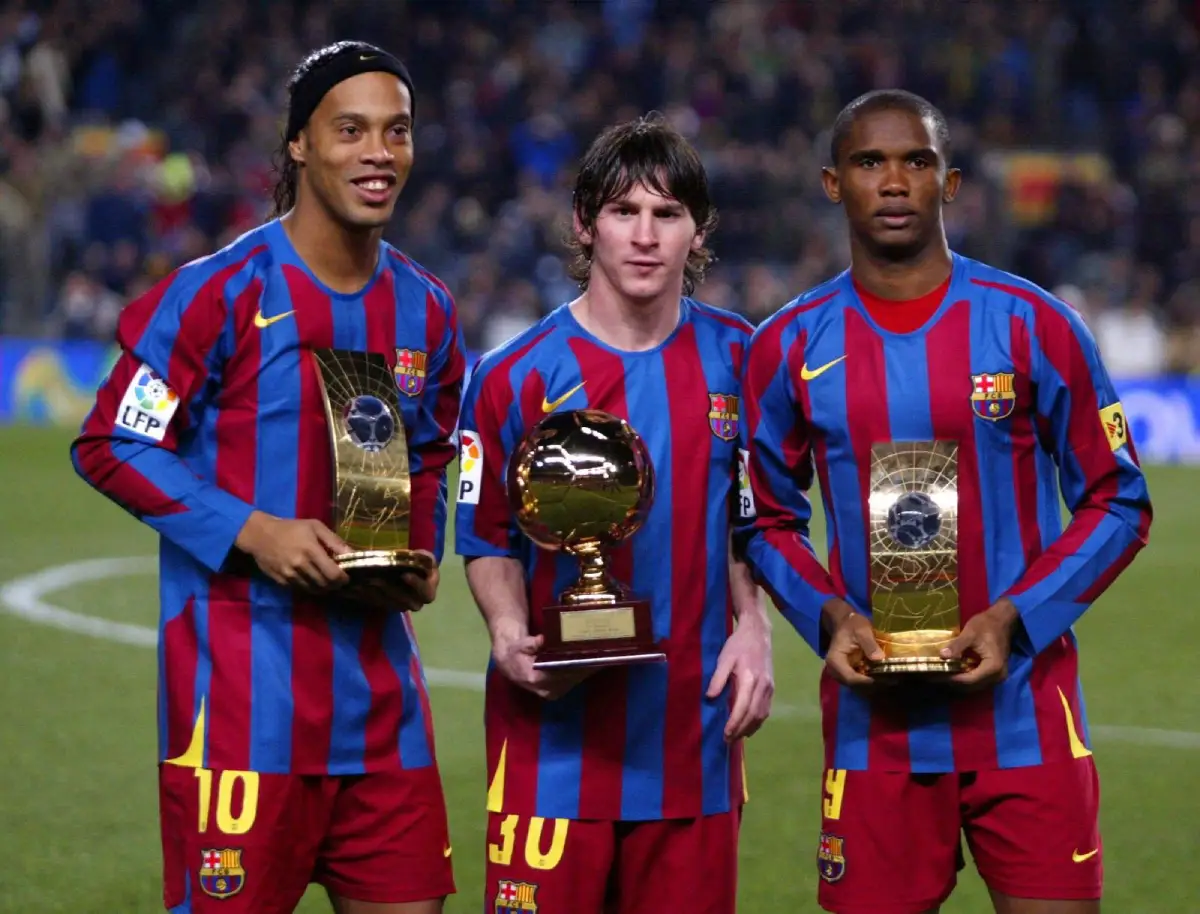
The following season was the best collective moment of this period. The attack was made up of Ronaldinho, Eto’o and Messi, a trio soon nicknamed “REM”. FC Barcelona retained the Spanish league title and won, above all, its second Champions League, beating Arsenal 2-1 in the final in Paris. Eto’o scored the equalizer, a quarter of an hour from the end, and Juliano Belletti gave the Catalans victory in the final minutes. Earlier, the Cameroonian had already stood out in the round of 16 against Chelsea, with a goal at Stamford Bridge with which he took revenge for the previous season’s elimination.
In the league, Eto’o went a step further. With 26 goals in La Liga, he finished for the second year running as the official top scorer of the Spanish championship and this time won the prestigious Pichichi, the award for La Liga’s top scorer. He was also decisive in Europe, with six goals in the Champions League, including the one in the final against Arsenal. At the end of the season, his performances earned him the UEFA Club Football Award for Best Forward, a further recognition of his place among the best center-forwards in world football.
This successful period nevertheless included a very hard episode. On 25 February 2006, at Real Zaragoza’s ground, part of the opposing fans racially abused Eto’o again and again.
In the 76th minute, fed up, he headed for the dressing room intending to leave the match. His teammates, the referee and some Zaragoza players stepped in to convince him to stay, and Frank Rijkaard finally managed to get him to play on. This episode showed once again the racist abuse the Cameroonian striker frequently faced in Spain.
At the end of 2005, Eto’o had also had to deal with a certain frustration on a personal level. While Ronaldinho won the Ballon d’Or, the Cameroonian finished only tenth, a position he considered disappointing given his performances. Even so, he came third in the FIFA World Player of the Year award and won the CAF African Footballer of the Year trophy for the third consecutive time. It was, therefore, an exceptional season, in which Eto’o definitively established himself as one of the great figures of Barça and of world football.
Injuries, tensions and a big comeback
After an excellent 2005-2006 season, 2006-2007 was much more complicated for Eto’o. The Cameroonian striker seriously injured his knee in a Champions League match against Werder Bremen, an injury that kept him off the pitch for almost five months. When he returned, in February 2007, he struggled to immediately recover his best level and had to adapt to a less dominant FC Barcelona than the one of the year before. There was also a major incident against Racing Santander: Frank Rijkaard left him on the bench and Eto’o refused to come on. Ronaldinho then publicly criticized him for individualistic behavior, which revealed the tensions that were beginning to run through the Catalan dressing room.
These sporting difficulties were compounded by tensions in the club’s board, then divided between those close to Joan Laporta and those close to Sandro Rosell. The summer of 2007 nevertheless brought new hope with the arrival of Thierry Henry from Arsenal. The announced partnership between Henry, Ronaldinho, Messi and Eto’o generated huge excitement and the Spanish press quickly dubbed this quartet the “Fantastic 4”. But injuries caught up with Eto’o again: in a friendly against Inter Milan, he suffered a fracture of the right femur that delayed his return even further.
His absence fueled rumors that he would leave. AC Milan, newly crowned European champions in 2007, was very interested and reportedly offered more than 60 million euros for his services. However, Eto’o decided to stay in Spain and continue his adventure with Barça. On 17 October 2007, he also obtained Spanish nationality and officially became a dual national.
He returned to action at the beginning of December and was quick to remind everyone of his importance. He scored in the Champions League against VfB Stuttgart and, three days later, netted a brace against Valencia CF in a 3-0 win. Despite taking part again in the 2008 Africa Cup of Nations with Cameroon, against the opinion of his club, which considered him still short of full fitness, he finished the season remarkably well. In just 18 La Liga matches he scored 16 goals and gradually regained his efficiency, although Barça was then going through a slump and once again ended the season without a single title. At the same time, Lionel Messi’s rise confirmed that a new attacking hierarchy was taking shape at the Camp Nou.
The Guardiola era and the redemption of the treble (2008-2009)
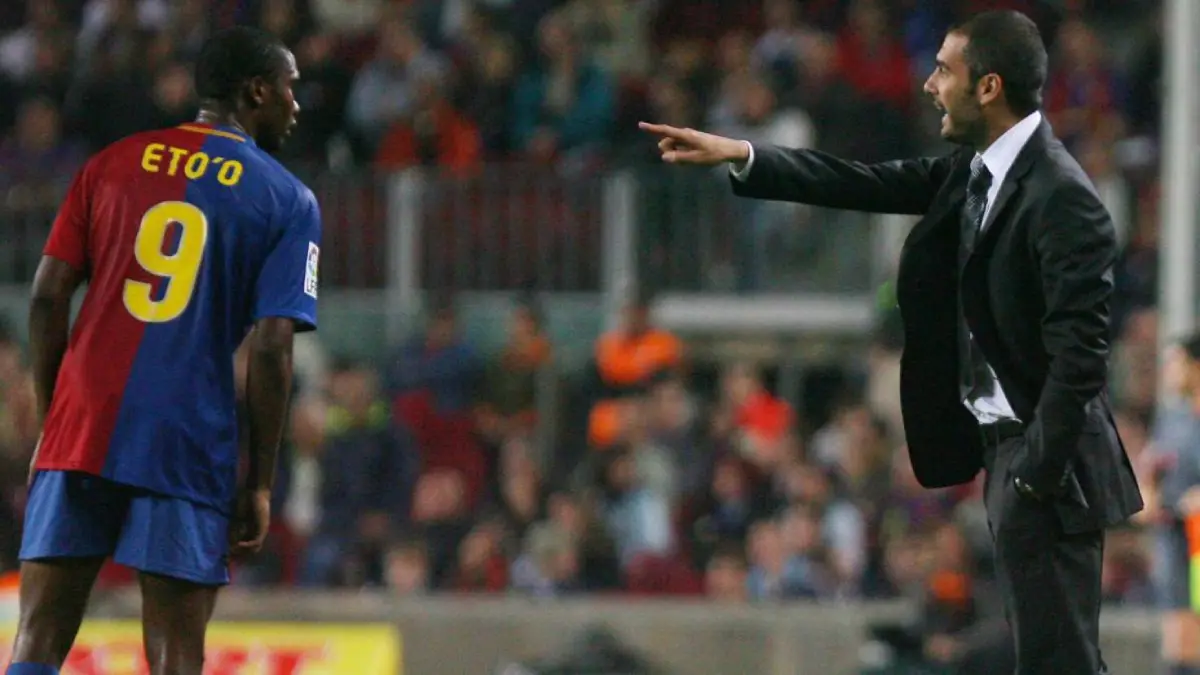
The summer of 2008 marked a major change at the club: Frank Rijkaard was dismissed and replaced by Pep Guardiola, a former Barcelona great beginning his first experience on a top-level bench. The new coach decided to part ways with the players held responsible for the excess of egos in the dressing room, starting with Ronaldinho and Deco. Eto’o, associated with that same group, saw his name linked with many clubs: from Chelsea to AC Milan, via Lyon, Tottenham and Manchester City, a possible return to Real Madrid and even an unusual offer from the Uzbek club FC Bunyodkor, which proposed an annual salary of 40 million euros.
But a convincing preseason, with eight goals in friendly matches, ended up persuading Guardiola to keep him. Guardiola’s decision paid off right away: Eto’o responded on the pitch and became one of the main architects of Barça’s exceptional season. In La Liga he scored 30 goals in 36 matches, including four against Real Valladolid and three against Almería, and was the league’s second-highest scorer, behind Diego Forlán. He was also decisive in the Champions League, where he scored six goals counting the qualifying rounds.
Barcelona won La Liga, then the Copa del Rey, and crowned this great season with another Champions League, won in Rome against Manchester United (2-0). Eto’o opened the scoring in the 10th minute and Lionel Messi doubled the lead. With this historic treble (La Liga, Copa del Rey and Champions League), the Cameroonian took a great revenge on those who had wanted him to leave the club a few months earlier.
His time at Barça ended with an impressive record: 154 goals in 200 matches in all competitions, making him one of the club’s top scorers of all time. Later on, moreover, the club’s members voted him the best number 9 in Barça’s history.
The departure to Inter Milan
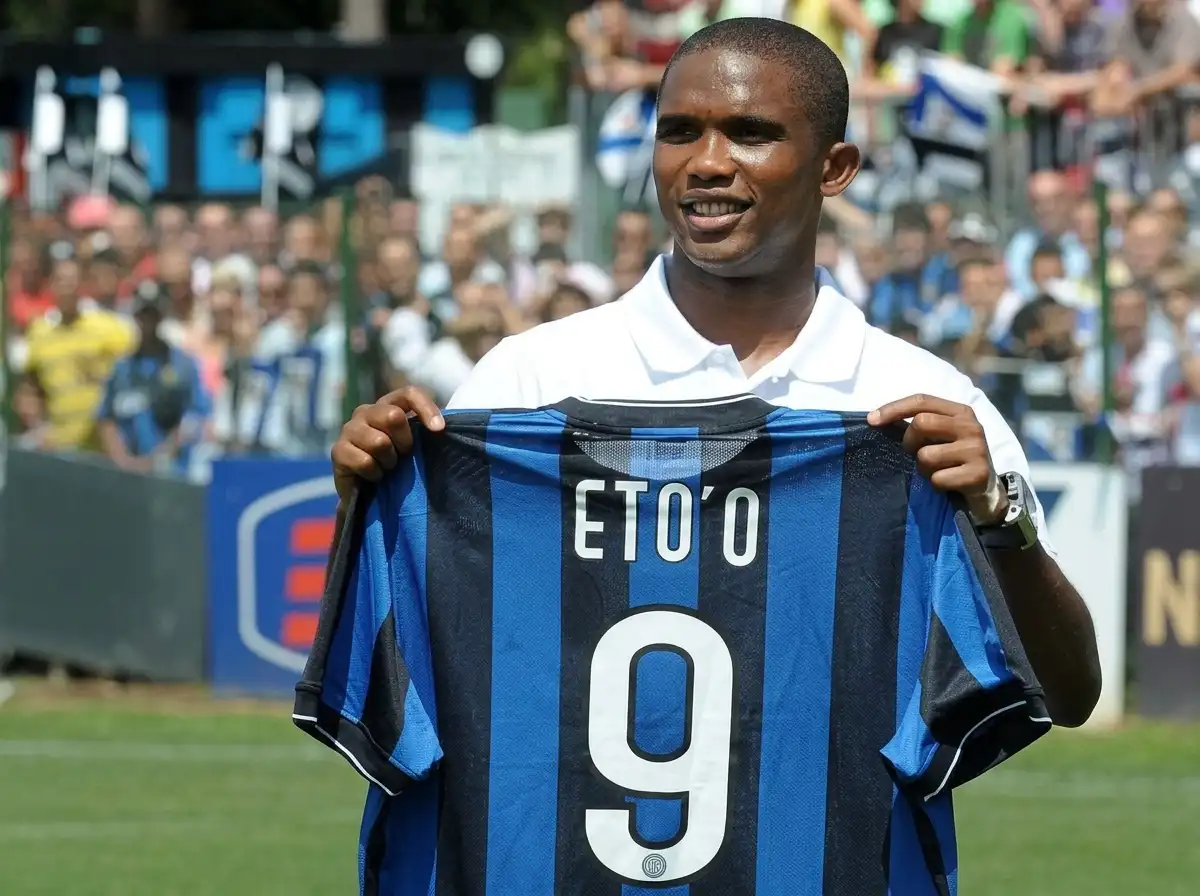
That victory in Europe was, paradoxically, the end of Eto’o’s Catalan chapter. Despite an excellent 2008-2009 season and a goal in the Champions League final, the Cameroonian striker was no longer really in Pep Guardiola’s plans for the future. The new coach wanted to rebuild the attack and FC Barcelona began looking for a new number 9, with Zlatan Ibrahimović as the priority. The negotiations ended in a spectacular exchange: on 27 July 2009, the Swedish striker arrived at Barça from Inter Milan, while Eto’o made the opposite journey, in a deal in which 46 million euros were also paid to the Italian club.
For Inter, the choice of Eto’o was no accident. José Mourinho saw in him a striker capable of making the difference in big matches, but also of pressing and working for the team. The Portuguese coach even thought the Cameroonian could make his team “more balanced” and said he had already wanted to sign him when he was at Chelsea. Inter had come off winning several Italian championships but was still looking to truly return to the top of Europe, and Eto’o’s profile, a two-time Champions League winner and goalscorer in the 2006 and 2009 finals, fitted that ambition perfectly.
For his part, Eto’o took on this new challenge with a lot of ambition. At his first press conference in Milan, he refused to get into comparisons with Ibrahimović: “I am Samuel Eto’o and I don’t want to be compared with anyone else.” And he made his goal clear: “I came to win the Champions League and I am where I want to be.” A few hours earlier, he had also said he was “very happy” to be joining Inter and had thanked president Massimo Moratti for his trust.
After five seasons at the Camp Nou, his record was eloquent: 154 goals in 200 matches in all competitions, three Spanish league titles and two Champions Leagues. Eto’o thus left Catalonia as one of the main architects of FC Barcelona’s return to the top during that decade of the 2000s. At 28, he turned the page on Barça and prepared to take on a new challenge in Italy, with a very clear ambition: to “make history” in the nerazzurri shirt.