
After leaving Cameroon at 15, Samuel Eto’o first tried his luck in France, passing notably through Marseille, Carpentras and Paris, before returning to Cameroon after several unsuccessful trials. Then scouted by Real Madrid during a match with the Cameroonian youth team, the young striker finally moved to Spain, where a pivotal period of his career began, made up of patience, successive loans and a slow rise that would lead him, over the space of seven seasons, from the status of young prospect to that of a striker coveted by Europe’s biggest clubs.
A prestigious contract, but few opportunities at Real Madrid (1997-2000)
Eto’o joined Real Madrid in 1997, recommended by former Spain international Francisco Gento, known as “Pirri”, who was impressed by the young Cameroonian’s technique during his observations.
But his status as a minor initially prevented him from joining the professional squad: he could only train with the reserve team, Real Madrid Castilla. When the latter was relegated to Segunda División B, a division in which non-EU players were not allowed to play, the club decided to loan him to the Spanish second division.
Decades later, when asked about the reasons for his early departure from Real Madrid, Eto’o himself would explain the context of that era: “Madrid, back then, had a different policy: superstars, galácticos. I was a young guy who was just taking his first steps, I had a lot of talent, a lot of drive, but that was the club’s project.” In a squad focused on big names, a teenager still unknown to the general public had very little room back then.
The breakthrough in the second division: the loan at Leganés (1997-1998)

It was therefore at CD Leganés that Eto’o played his first full season of professional football. He made his debut on 30 August 1997, wearing number 11, in a 1-0 win against Eibar, in which he played 51 minutes. His first goal came a few days later, on 10 September, against Vallecas in the Copa del Rey, before he scored three more goals in the league against Toledo, Albacete and Logroñés. On 14 February 1998, he was part of the starting eleven that inaugurated the brand-new Butarque stadium, against Xerez. Over the whole season, he played 30 matches and scored 4 goals with Leganés.
It was also during this period, while he was playing in the Spanish second division, that Eto’o was called up for the first time to Cameroon’s senior team by the French coach Claude Le Roy. This call-up took him straight to the 1998 World Cup in France, where he became, at 17 years and 3 months, the youngest player of the tournament in the 3-0 defeat against Italy.
A difficult return to Madrid, then a new loan at Espanyol (1998-1999)
Back at Real Madrid for the 1998-1999 season, Eto’o played only one match with the Merengue club, in La Liga against Espanyol Barcelona. The Madrid management then decided to loan him to that same Catalan club for the second part of the season, from January 1999. His spell there was very brief: he played only one official match, coming on as a substitute in February 1999 against Real Valladolid in the Copa del Rey.
Blocked by the competition (1999-2000)
For the 1999-2000 season, Eto’o rejoined the Real Madrid squad for the last time, but the competition remained formidable, with Raúl, Fernando Morientes and new signing Nicolas Anelka. The young Cameroonian nevertheless played seven matches, including three in the Champions League, and took his first steps in the competition on 21 September 1999 against Molde (4-1). Although he did not score any goals, these appearances allowed him to taste the very highest level of European football. In January 2000, he was loaned to RCD Mallorca for six months with an option to buy, a step that would quickly change the course of his career. Despite his limited playing time at Madrid, Eto’o thus won his first Champions League, with Real beating Valencia in the final.
The big leap at Mallorca (2000-2004)
The decisive turning point of his career came in the winter 2000 transfer window: Eto’o was loaned to RCD Mallorca, where he scored 6 goals and provided 4 assists in 13 La Liga matches. Convinced by his potential, the Balearic club then bought 50% of his rights for 7.2 million euros, while Real Madrid kept part of the player’s rights. From his first full season, the Cameroonian contributed to Mallorca’s third place in La Liga with 11 goals and made his debut in the Champions League, where he scored his first goal in the competition against Hajduk Split.
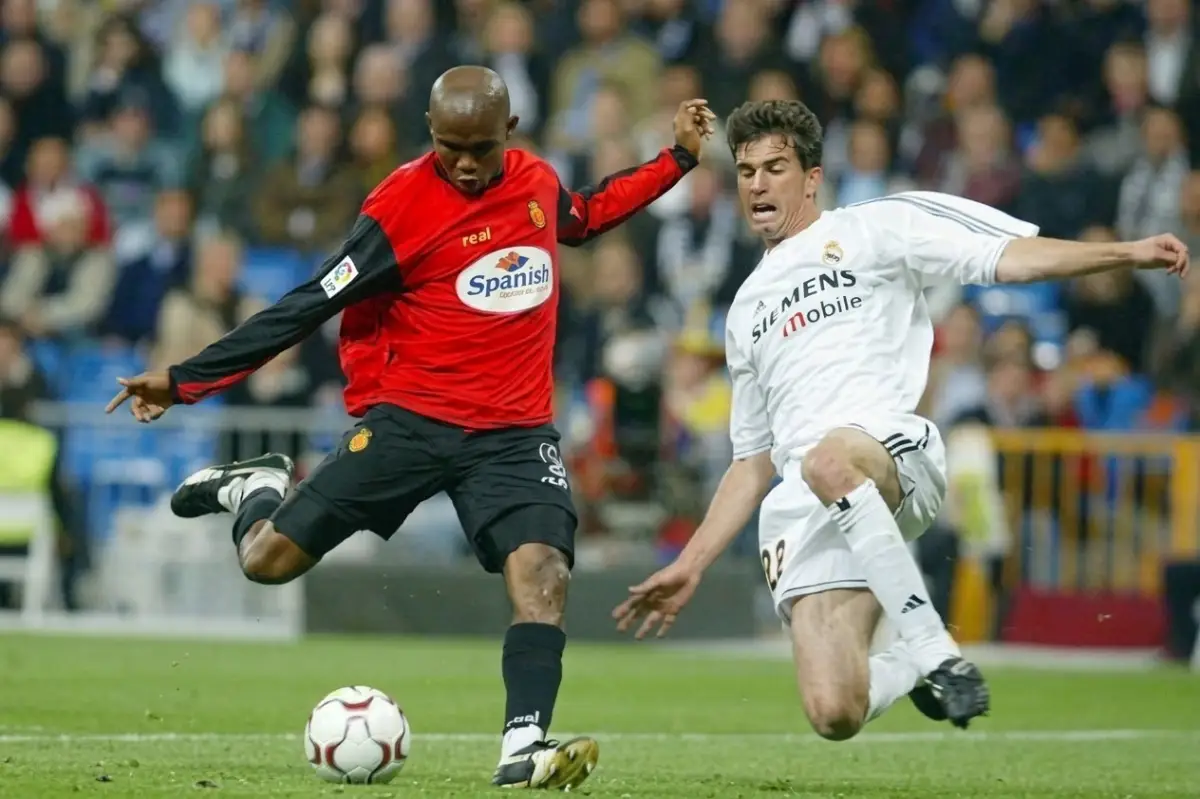
After a more difficult 2001-2002 season, Eto’o took a leap forward in 2002-2003: in particular, he contributed to the spectacular 5-1 win against Real Madrid with one goal and two assists, before scoring a brace in the Copa del Rey final against Recreativo Huelva (3-0). This first major trophy was accompanied by his first CAF African Footballer of the Year award in 2003. This stage at Mallorca thus reached its high point with the Copa del Rey triumph, a success to which Eto’o remains particularly attached. Driven by the fervor of the supporters who accompanied him to that final, he wanted to show them his gratitude by personally financing part of their travel expenses to attend the match.
The 2003-2004 season confirmed his status as a rising star. Despite a modest 11th place for Mallorca in the league, Eto’o again stood out against his former club, Real Madrid, scoring a brace. He first opened the scoring after a forty-meter sprint, with a shot over Iker Casillas, before putting his team back in front after a series of dribbles that ended with an unstoppable strike. In the UEFA Cup, the Cameroonian was just as decisive: in the first round, he scored a hat-trick in the second leg against APOEL Nicosia (4-2), allowing Mallorca to continue their European run. The Spanish club then eliminated FC Copenhagen in the second round, then Spartak Moscow in the round of 32, with a goal from Eto’o in the 3-0 away win. The European adventure finally came to an end in the round of 16 against Newcastle United, but Eto’o once again demonstrated, through his performances in the league as well as on the European stage, that he now had what it took to compete at the highest level. His progress was such that, as early as 2003, he caught the attention of Olympique Lyonnais, which was booming on the European scene at the time, although that transfer never materialized.
Real Madrid’s executives, focused on their star-signing policy, did not realize at the time that they had let one of the best bargains of their recent history slip away. At Mallorca, Eto’o blossomed fully over four seasons and scored a total of 70 goals in all competitions, a record at the time for the club, which will remain associated with his name for a long time. After four years in the Balearics, he finally left the club in the summer of 2004 with 54 goals in La Liga, becoming Mallorca’s all-time top scorer in the Spanish top flight. His performances also attracted the attention of Europe’s most important clubs, and FC Barcelona ended up signing him in the summer of 2004.