
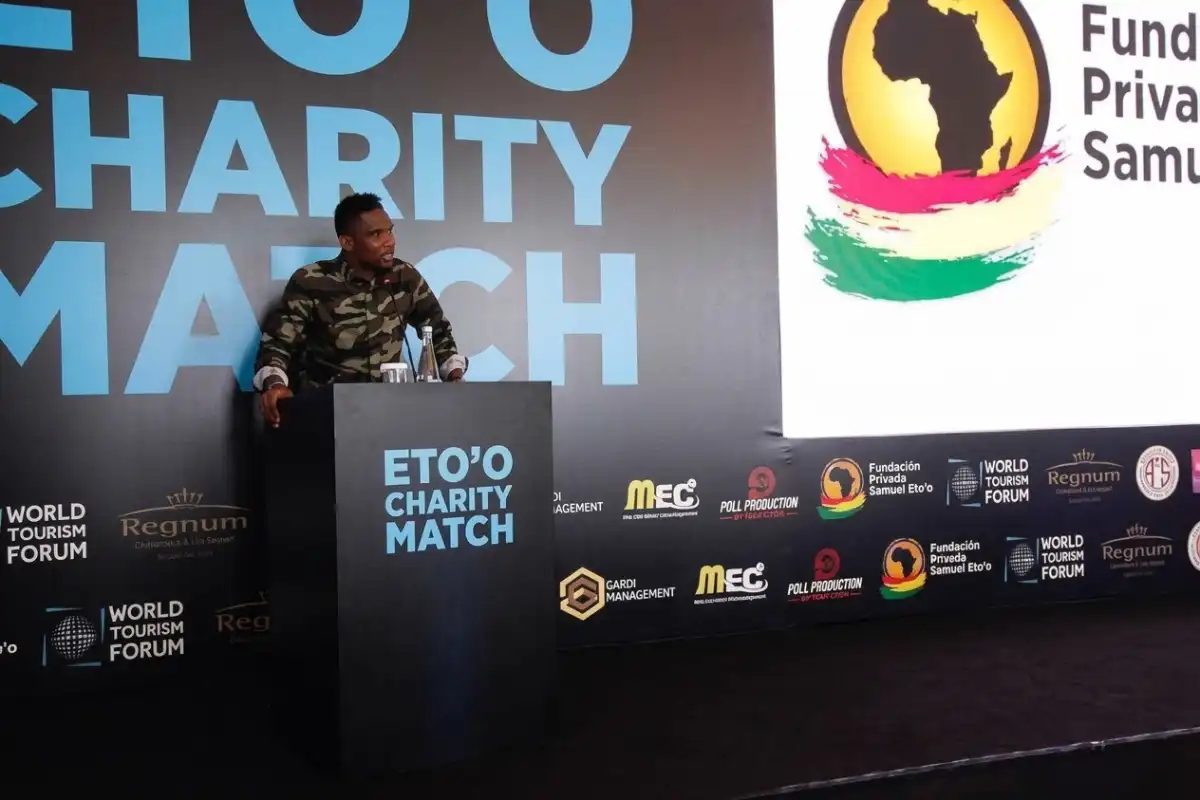
Created in March 2006 by former Cameroon international Samuel Eto’o Fils, then at the peak of his career with FC Barcelona, the Samuel Eto’o Foundation is a non-profit organization dedicated mainly to the protection and support of children and young people in Africa. Its actions have centered in particular on education, health, sport and social integration, with special attention to the most vulnerable populations.
Football has naturally held an important place in this initiative, notably through the Fundesport project, conceived as a tool for the training and support of young African talents. Over the years, the foundation also developed initiatives in the fields of health and education, such as the Samuel Eto’o pediatric ward at Laquintinie Hospital in Douala.
Now that Samuel Eto’o presides over the Cameroonian Football Federation (FECAFOOT), we look back at the foundation’s origins, its main missions, its most notable achievements and its evolution over the years.
Creation and objectives
The project’s origins go back to 2005, when Samuel Eto’o organized in Douala the first edition of the “Festi Espoir Eto’o”, an event designed to spot and support young Cameroonian footballers. Following this initiative, the idea gradually took shape: to offer young talents, particularly those from disadvantaged backgrounds, a structured framework allowing them to develop their sporting abilities and envisage a professional career. It was in this continuity that the Fundesport project (a contraction of Fundación Samuel Eto’o Sport) was created, becoming the foundation’s main sports component.
In March 2006, Samuel Eto’o made the creation of his foundation official, with an ambition that gradually went beyond football alone. The organization aims to use the player’s fame and experience to improve the living conditions of disadvantaged children and young people in Africa, giving an important place to education, health and social integration. The foundation’s presentation texts also highlight its desire to support initiatives aimed at reducing poverty and inequality and creating new opportunities for young people.
Football nevertheless remains at the heart of the project’s first phase. With Fundesport, the aim is not simply to train players, but to make sport a tool for development and integration. The program thus aims to give young African athletes, girls as well as boys, access to structured sports training while also promoting their preparation for professional life. The project’s first years were marked in particular by the establishment of a training center in Douala and the identification of young talents through various tournaments.
The Samuel Eto’o Foundation and its sports component Fundesport then obtained recognition of public utility by presidential decree on 20 November 2008, an important milestone in the institutionalization of the project and in its desire to extend its actions beyond the sporting sphere.
The Fundesport project: structure and operation
Fundesport was progressively structured around five training centers, four of them in Cameroon, notably in the cities of Douala, Yaoundé, Limbé and Bamenda, and one in Gabon, in Libreville. The stated aim was to give young African athletes, girls and boys, a framework allowing them to progress in sport while preparing their entry into professional life. Football was thus meant to serve as a lever for social, cultural and economic development, beyond the mere pursuit of sporting performance.
The project’s operation was also based on an educational and social dimension. The foundation sought to combine sports practice with schooling and with awareness-raising on issues such as agriculture, rainwater management and reforestation, with the idea of also involving local communities. Sport was also presented as a means of promoting the integration of children with disabilities.
One of Fundesport’s main successes lies in the bridges created to Europe. Several young people from the program thus joined La Masia, FC Barcelona’s training center, among them Lionel Enguene, Jean-Marie Dongou and Gaël Etock. Fabrice Olinga also came through Fundesport before moving to Spain and becoming a Cameroon international.
The structure’s ambition was not, moreover, limited to men’s football. A women’s handball project was notably developed as part of a partnership with BM Atlético de Madrid, illustrating the desire to gradually extend the foundation’s activities to other sports.
On the pitch, the results were also significant: Fundesport’s teams won three national youth titles between 2010 and 2011, and several players trained at the center went on to join Cameroon’s national teams.
Footballers who came through Fundesport
Fundesport made its mark above all through its ability to spot young Cameroonian talents and open the doors of European football to them. Its link with FC Barcelona notably allowed several of its academy students to join La Masia, creating a genuine bridge between Samuel Eto’o’s academy and one of the world’s most renowned training centers.
The two best-known examples remain André Onana and Fabrice Ondoa. The two cousins came through the Samuel Eto’o Foundation before joining Barça’s youth academy. Ondoa went on to be Cameroon’s starting goalkeeper during the triumph at the Africa Cup of Nations 2017, while Onana has established himself at the highest European level, notably with Ajax Amsterdam, then Inter Milan and afterwards Manchester United. FIFA had in fact highlighted in 2017 the parallel paths of the two goalkeepers, both of whom came through the Foundation and then La Masia.
Jean-Marie Dongou and Lionel Enguene are also part of this generation of young Cameroonians who joined Barça after their time at Fundesport. Their performances with the Catalan youth teams had at the time raised great expectations around a possible new generation of talents coming from Samuel Eto’o’s center.
Another notable success is Fabrice Olinga, who also came through Fundesport before continuing his training in Spain. He quickly made a name for himself by becoming, with Málaga, the youngest goalscorer in La Liga history up to that point, at just 16 years and 98 days, before in turn joining the Cameroon national team.
Beyond these names, Gaël Etock, Wilfrid Kaptoum, Macky Bagnack, Serge Leuko and several other academy students also continued their careers in Europe. This pipeline thus illustrates one of Fundesport’s central ambitions: to identify young people from sometimes modest backgrounds, offer them structured training and expose them early enough to top-level football for them to try their luck in the professional world.
Social and humanitarian actions
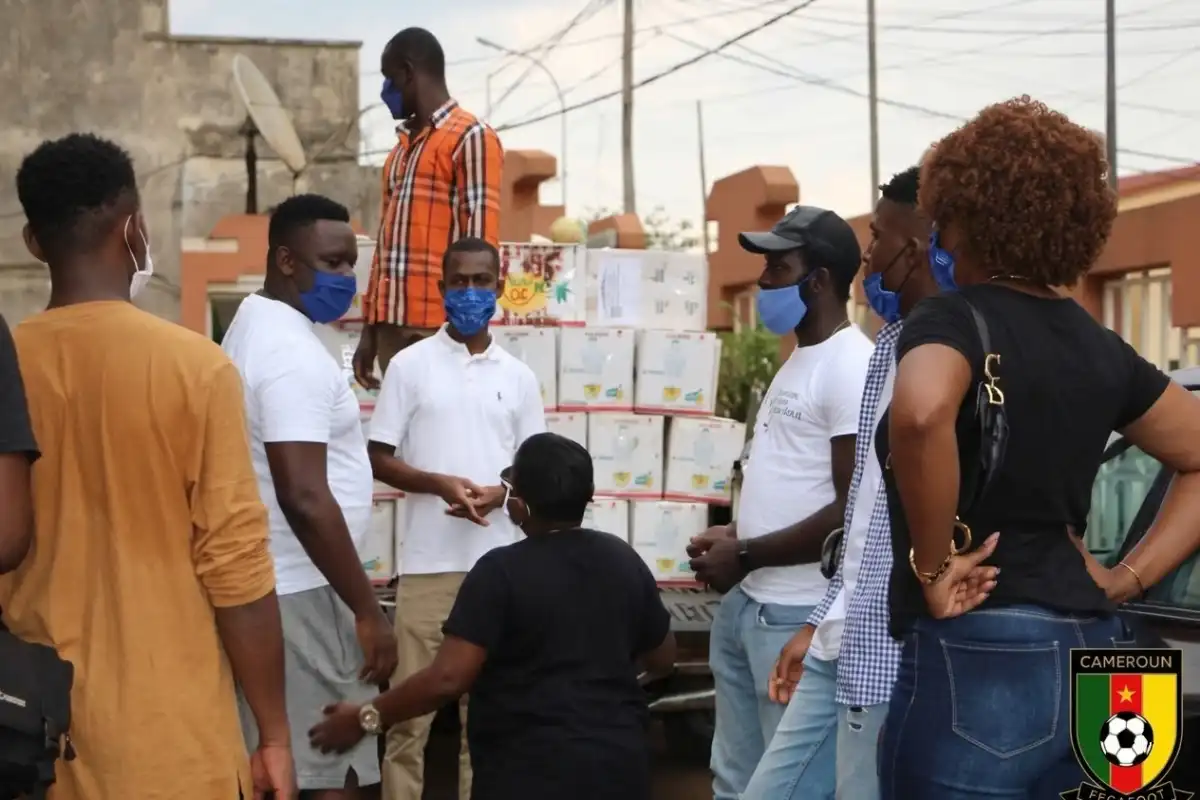
Beyond Fundesport, the Samuel Eto’o Foundation progressively developed a social component around three priorities: education, health and the protection of vulnerable children and young people. As early as 2008 it stated, in particular, that it supported the best students at the University of Yaoundé II through an annual program of 80 study grants, while also contributing to the modernization of the computing infrastructure of several schools. On the humanitarian front, the foundation also states that it has contributed to the development of five orphanages in Cameroon, illustrating its desire to help children deprived of family support.
Health is another historic focus. In 2008, a partnership with USP Fundación Alex, based in Barcelona, was meant to enable Cameroonian children aged 1 to 14 suffering from conditions that are difficult to treat locally to access specialized hospital care. This initiative corresponded to one of the foundation’s stated ambitions: to use its international networks to offer certain children medical care possibilities that were not easily available in Cameroon.
Nevertheless, one of the best-documented humanitarian operations is the one carried out during the Covid-19 crisis in 2020. The “Stop Covid-19” campaign provided for the distribution of health and food kits to 50,000 households in Douala, Yaoundé, Buea and Bafoussam. The foundation had also planned kits for 1,000 footballers and coaching staff from Cameroon’s top-flight leagues, as well as the manufacture of 50,000 washable masks, notably for taxi and motorbike-taxi drivers. FECAFOOT officially confirmed having received the donations intended for the players and coaching staff of Elite One, Elite Two and the women’s championship.
Timeline: rise, closure and end of activities
The foundation’s path has not been linear. At the end of 2014, Samuel Eto’o closed Fundesport, dismissing all staff except its director. This decision came amid personal tensions experienced by the player in Cameroon, reported at the time by several Cameroonian media outlets, a few months after his tense departure from the national team.
In July 2016, to celebrate the foundation’s tenth anniversary, an “Eto’o Charity Match” was due to bring together in Turkey several great figures of world football, including Lionel Messi, Neymar, Didier Drogba, Xavi and Michael Essien. The event was ultimately postponed following the attempted coup in the country a few days before it was due to take place.
The foundation then continued its activities on a more occasional basis, with a renewed visibility in 2020 and 2021 thanks to its actions during the Covid-19 pandemic. In March 2021, it notably covered the school fees of a young girl named Habiba.
Since that date, no official communication or public action has been recorded on the foundation’s channels. This halt coincides with Samuel Eto’o’s election as president of the Cameroonian Football Federation (FECAFOOT) on 11 December 2021.
Funding
The information available on the foundation’s funding comes mainly from the press, as the organization has not published a consolidated financial report. According to some media reports, the amounts allocated changed significantly over the course of Samuel Eto’o’s career.
As early as 2007, while he was still playing for FC Barcelona, the Spanish daily Público reported that the foundation devoted around 31,000 euros a year to helping some 5,000 children in various African countries. A few years later, at the height of his career, the magazine Jeune Afrique estimated the annual budget of the Fundesport component alone at around 300,000 euros (196.5 million CFA francs), a sum then entirely financed by the player himself and managed by his coordinator, Hermine Isson. Later still, 20 Minutes (Sportune) reported a markedly higher financial commitment, with around 2 million euros paid each year by Samuel Eto’o for the benefit of children living in Yaoundé, a period coinciding with the highest earnings of his playing career, notably during his time at Anzhi Makhachkala.
These figures, reported at different times, illustrate a rise in Samuel Eto’o’s personal financial commitment to his foundation, although no public data exist that would allow a complete and continuous accounting of the structure over its entire existence to be reconstructed.