
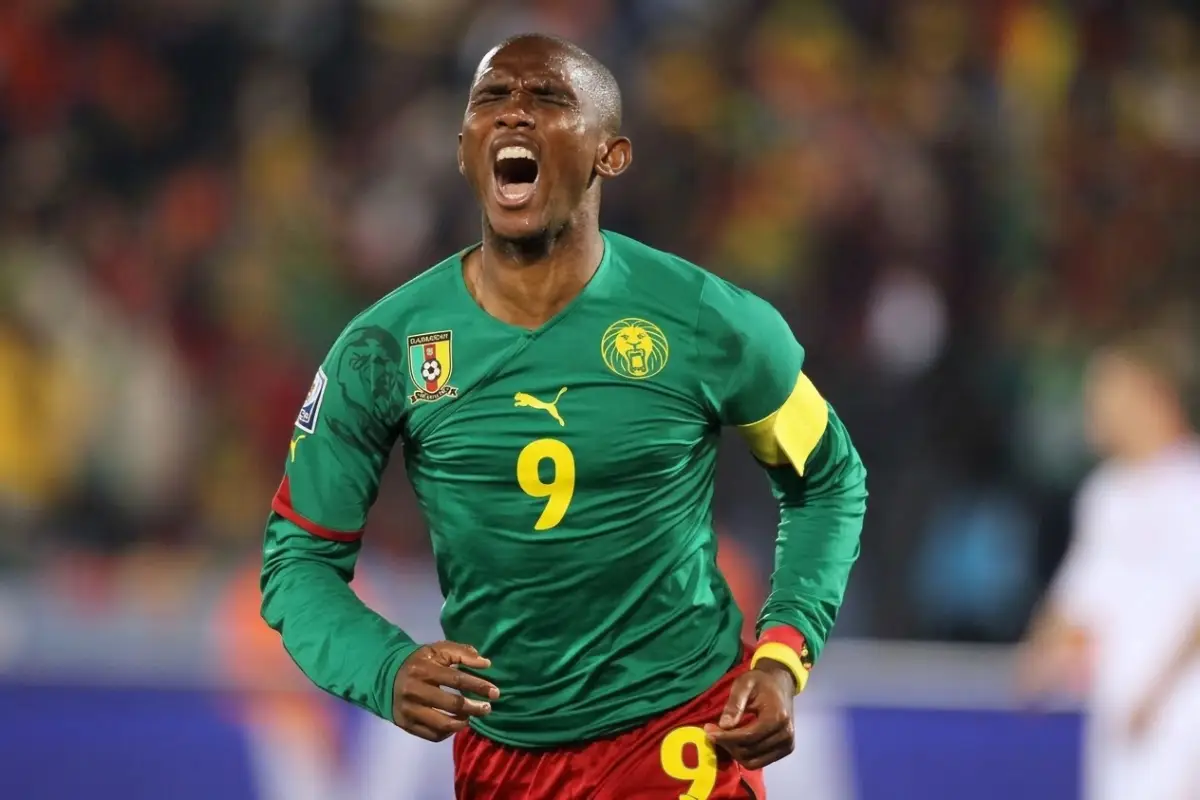
Between 1997 and 2014, Samuel Eto’o wore the Cameroon shirt 118 times and scored 56 goals, a total that still makes him the all-time top scorer of the Indomitable Lions. His career with the national team was as rich as it was eventful, marked by continental and Olympic titles, but also by disappointments at the World Cup and several internal tensions that, at certain times, went far beyond the sporting sphere.
The great peaks: the double of 2000 and the continental conquest of 2002
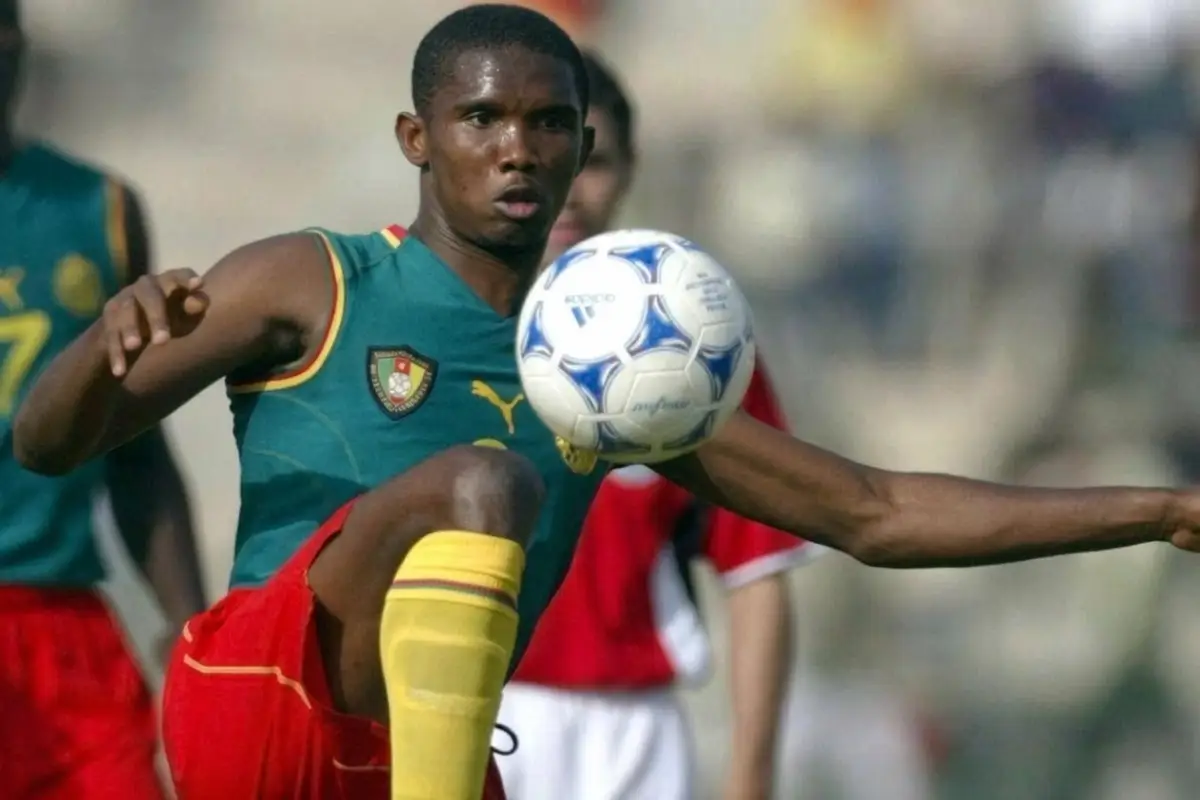
Samuel Eto’o joined the Cameroonian national teams very early on. After taking his first steps with the cadet team at 13 or 14, he soon moved up to the youth team, where he already stood out for his efficiency. But it was with the Indomitable Lions that he truly revealed himself at the highest level. Called up for the first time by Claude Le Roy when he was still playing for CD Leganés, he took part in the 1998 World Cup in France, at only 17 years and 3 months, and became the youngest player of the tournament. Still a substitute behind Patrick Mboma and François Omam-Biyik, he could not prevent Cameroon’s elimination in the group stage, but that experience was the beginning of a long story with the national team.
After a quieter period in 1999, marked by a lack of playing time at his club, his loan to Mallorca restored his confidence and gradually placed him among the great hopes of Cameroonian football. He truly exploded at the 2000 Africa Cup of Nations, hosted by Ghana and Nigeria. At only 18, Eto’o scored four goals in the tournament, one of them in the final against Nigeria. After a spectacular 2-2 draw, the Indomitable Lions won the penalty shootout (4-3) and claimed the third continental title in their history. Eto’o finished as the tournament’s second-highest scorer, level with his compatriot Patrick Mboma.
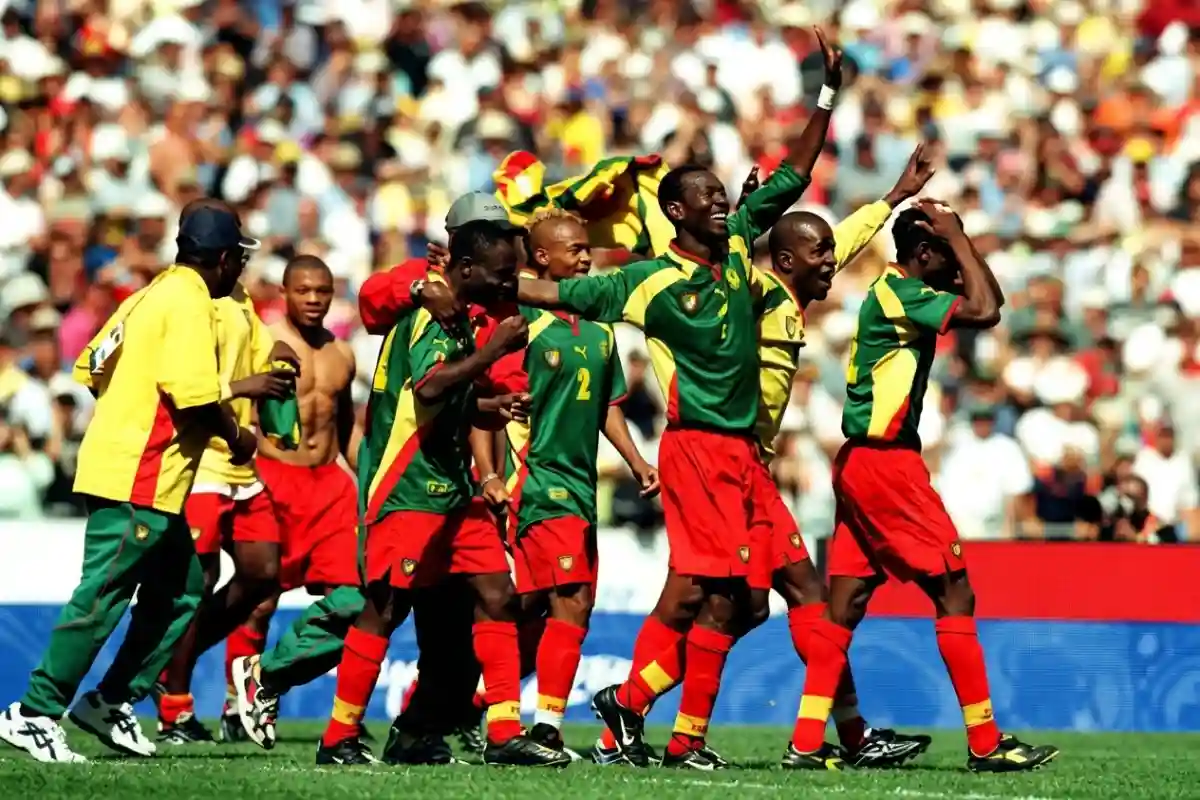
A few months later, the young striker added another major line to his honors list. At the Sydney Olympic Games, Cameroon reached the final against a Spain side that included Xavi, Carles Puyol and Carlos Marchena in its ranks.
With the score 2-1 against them, the Cameroonians could count on Eto’o, who equalized and took the match to a penalty shootout. He then converted his own kick in a shootout won 5-3. Cameroon thus won the Olympic gold medal and became the second African nation to win the men’s football tournament at the Olympic Games. In a few months, Eto’o had established himself as one of the figures of the new Cameroonian generation and had won two major competitions with his national team.
The following year, Cameroon confirmed its status as an African power. As reigning continental champions, the country reached the 2001 Confederations Cup, where Eto’o played all three group-stage matches and then featured in the team of the tournament, despite the Lions’ elimination. But it was above all in 2002 that the golden Cameroonian generation left a lasting mark on history. At the Africa Cup of Nations in Mali, Eto’o was less prolific, with a single goal, scored in the group stage against Togo, but Cameroon advanced to the final after eliminating Egypt and then Mali. Against Senegal, the two teams could not be separated after 120 minutes and the Indomitable Lions won on penalties again (3-2). Eto’o, who did not take part in the shootout, thus won his second consecutive African championship title.
A few months later, he played in his second World Cup, in South Korea and Japan. Cameroon failed to get out of the group stage, despite a draw against Ireland and a win against Saudi Arabia, secured thanks to a goal from Eto’o. These difficulties at the World Cup contrasted with the Lions’ dominance on the African stage. Between 2000 and 2002, Cameroon thus won two consecutive Africa Cups of Nations and an Olympic gold medal, while Eto’o gradually established himself as one of the leaders of a generation destined to leave a lasting mark on the history of African football.
Successive failures: when disappointments pile up (2004-2010)
After reaching the summit of African football with the Indomitable Lions in the early 2000s, Samuel Eto’o entered a much more uneven period with the national team. Cameroon remained a major power in African football, but titles now eluded Eto’o’s teammates, and several important occasions ended in disappointment.
The 2004 Africa Cup of Nations in Tunisia marked the beginning of this more complicated period. Reigning champions and presented as one of the tournament’s big favorites, Cameroon finished top of their group after a win against Zimbabwe and two draws. In the quarter-finals, the Indomitable Lions faced Nigeria and took an early lead thanks to Eto’o, who opened the scoring in the 43rd minute. But the Super Eagles turned the match around (2-1) and ended Cameroon’s ambitions. That goal did allow the striker, though, to end an unusual run of six international matches without scoring, the longest drought of his career with the Lions.
The biggest disappointment came a few months later. In the 2006 World Cup qualifiers, Cameroon found itself in a particularly tough group with Egypt and Ivory Coast. In a good position for a long time, the Lions played for qualification on the final matchday against the Pharaohs, in Yaoundé. With Egypt having just equalized and the score at 1-1, Cameroon won a penalty in added time. Pierre Womé took responsibility, but his shot hit the post. At the same time, Ivory Coast beat Sudan and secured qualification for Germany. For the first time since 1990, Cameroon missed a World Cup, ending a run of four consecutive appearances. It was a night that long remained one of the traumas of Cameroonian football.
Even so, Eto’o responded in the best possible way on the pitch at the 2006 Africa Cup of Nations in Egypt. From the first match against Angola, he scored a hat-trick in a 3-1 win, and then also scored against Togo and the Democratic Republic of the Congo. With five goals, he finished as the tournament’s top scorer and became the all-time top Cameroonian scorer in the competition’s history. His adventure came to an abrupt end in the quarter-finals against Ivory Coast. After a 1-1 draw, qualification was decided in an interminable penalty shootout. Eto’o first converted his first attempt, but had to step up a second time after all 22 players had scored theirs. This time he missed and Cameroon was eliminated. It was a cruel ending for the striker, who had just put together one of his best individual campaigns with the national team.
Two years later, the script repeated itself almost identically. At the 2008 Africa Cup of Nations in Ghana, Eto’o once again carried Cameroon’s attack. He scored a brace in the first match against Egypt and then found the net again against Zambia and Sudan. Cameroon then eliminated Tunisia in the quarter-finals and Ghana in the semi-finals, and met Egypt again in the final. The Lions finally lost 1-0 to a goal from Mohamed Aboutrika. Eto’o still finished as the competition’s top scorer with five goals, for the second consecutive Africa Cup of Nations, and raised his total to 16 goals in the tournament, surpassing Laurent Pokou’s record of 14. He would later become the first player to reach 18 goals in the finals of the Africa Cup of Nations, a record that remains unmatched today.
But this period was not only about disappointments. In the 2010 World Cup qualifiers, Eto’o had one of his most prolific spells with Cameroon. He scored eight goals in the first six qualifying matches and contributed greatly to the Lions’ return to the world stage. After the disappointment of 2006, Cameroon finally secured its ticket to the South Africa World Cup. Eto’o also took back the captain’s armband in August 2009, succeeding Rigobert Song, who had worn it for almost a decade.
The 2010 Africa Cup of Nations in Angola was another disappointment. Beaten in their opening match by Gabon, Cameroon reacted by beating Zambia, partly thanks to Eto’o, and then drew with Tunisia. Second in their group, Cameroon reached the quarter-finals, but met Egypt again, who had become their real nemesis. The Pharaohs won 3-1 after extra time and ended the Cameroonians’ run.
A few months later, Eto’o played in his fourth and last World Cup, in South Africa. Cameroon had a particularly difficult tournament and lost all three of their group matches, against Japan, Denmark and the Netherlands. Eto’o scored against the Danes and then against the Dutch, but his two goals were not enough to avoid elimination. With this new early exit, Cameroon left the competition without winning a single match. Eto’o thus took part in four World Cups, in 1998, 2002, 2010 and 2014, but never got past the group stage with the Indomitable Lions.
Between 2004 and 2010, the record was therefore paradoxical. Eto’o kept piling up goals and records, becoming the all-time top scorer of the Africa Cup of Nations with 18 goals and the all-time top scorer of the Indomitable Lions. But as a team, Cameroon could no longer return to the heights of the early 2000s. The Indomitable Lions strung together disappointments, with three quarter-final eliminations at the Africa Cup of Nations, two finals lost in 2008, a World Cup missed in 2006 and another group-stage exit in 2010. It was a period in which, despite his goals, his records and his growing influence, Samuel Eto’o’s exceptional talent was no longer enough to make up for the difficulties of a national team that nonetheless remained one of the great references of African football.
The chaos of 2014: the culmination of tensions with the federation
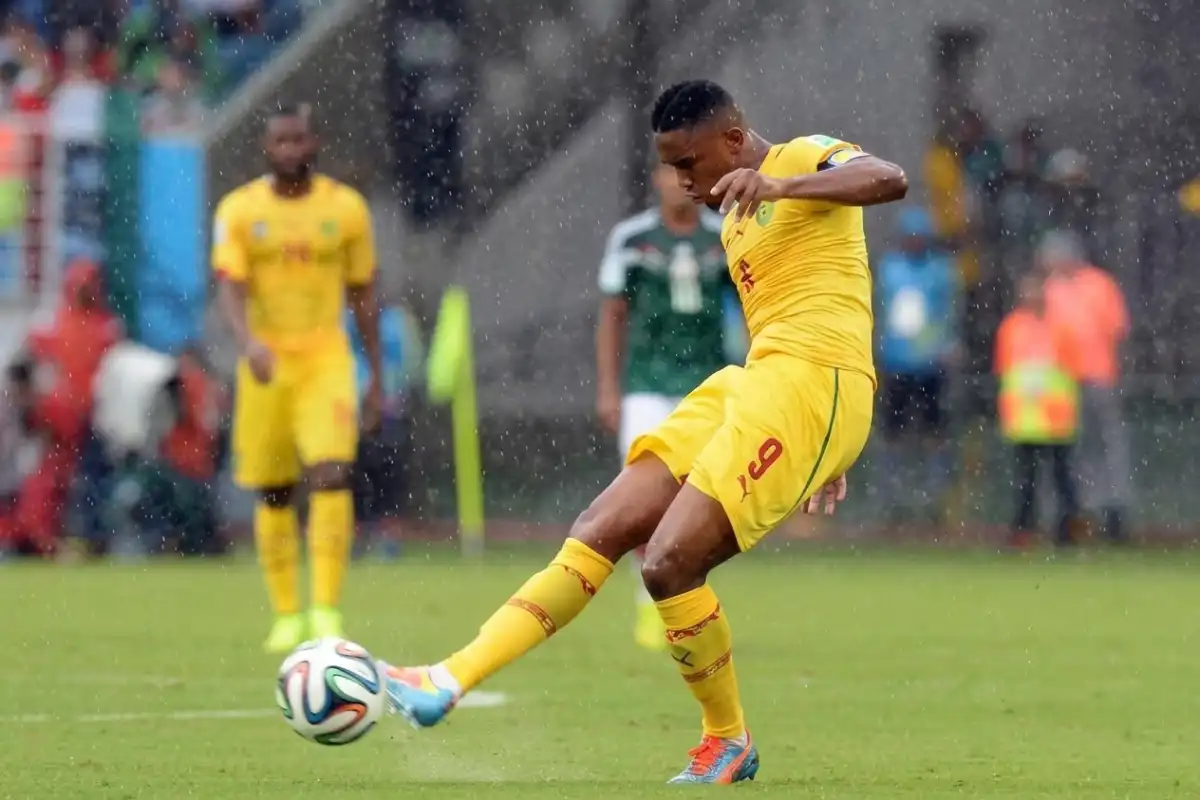
The last World Cup played by Samuel Eto’o, in Brazil in 2014, came after several years of particularly tense relations between the striker and the Cameroonian football authorities. As early as 2011, the dispute over bonuses had reached a breaking point.
On 15 November, the players refused to travel to Algeria to play a friendly, denouncing the non-payment of bonuses promised after a tournament in Morocco.
As captain of the Indomitable Lions, Eto’o was regarded by FECAFOOT as one of the main instigators of the revolt and received a heavy sanction: a 15-match suspension in December 2011. A few weeks later, the Federation reduced the penalty to eight months, under pressure in particular from President Paul Biya, which left the sanction at only a few missed official matches.
The episode did not put an end to the tensions. Once his suspension was over, Eto’o refused to return to the national team immediately, believing that the organizational and management problems he had denounced as captain had not been resolved. In August 2012, when he was called up to face Cape Verde in the qualifiers for the 2013 Africa Cup of Nations, he thus announced that he was suspending his return to the national team. He ended up coming back a few weeks later, after another intervention by the Cameroonian authorities, but that was not enough to save the Lions, who were eliminated by Cape Verde and absent from the 2013 Africa Cup of Nations.
Even so, Eto’o regained a central role in the qualifying campaign for the 2014 World Cup. After missing the first two matchdays, he scored a decisive brace against Togo in March 2013 and helped Cameroon return to the top of their group. He then took back the armband and took part in the play-offs against Tunisia, which the Indomitable Lions won with a 0-0 draw in the first leg and a big 4-1 win in Yaoundé. Cameroon thus secured qualification for its seventh World Cup, and Eto’o returned, for the fourth time in his career, to the most prestigious of international competitions.
But in Brazil the old demons resurfaced. A few days before the start of the tournament, the players refused to board the plane scheduled to fly to Brazil over a disagreement about participation bonuses. The dispute was eventually settled and the departure was delayed by almost a day, illustrating once again the particularly conflictual relationship between the players and their federation.
On the pitch, the fiasco was total. Cameroon first lost 1-0 against Mexico and then collapsed against Croatia (0-4), in a match marked by the sending-off of Alexandre Song and, above all, by a surreal scene at the end: Benoît Assou-Ekotto tried to attack his teammate Benjamin Moukandjo before Pierre Webó stepped in to separate them. The team looked completely disunited, while Volker Finke publicly condemned the behavior of some of his players.
As if that were not enough, Cameroon then became embroiled in a match-fixing suspicion case. A month after the tournament, FECAFOOT announced the opening of an investigation into fraud allegations against several players, especially around the match against Croatia. These allegations came in particular from the Singaporean Wilson Raj Perumal, who has a criminal record and reportedly mentioned, before or around the match, certain elements that matched the way the game played out. It is essential to speak of suspicions and not established facts: the allegations were disputed and no evidence was publicly established to claim that the Cameroonian players had rigged the match. FIFA itself had indicated that it did not wish to comment on a possible investigation so as not to compromise it.
In this already explosive context, Samuel Eto’o appeared as a much less influential figure than before. Hampered by a knee injury, the striker played only the first match against Mexico and watched from the bench as his team collapsed. Cameroon finally lost all three group matches, conceding nine goals and scoring only one, and left Brazil without a single point.
The end of the international adventure (August 2014)
A few weeks after that failed World Cup, on 27 August 2014, Eto’o officially announced his international retirement, ending 17 years with the Indomitable Lions. He left the national team with a record that alone sums up the importance of his legacy: 56 goals, Cameroon’s all-time record, and an international career marked by two Africa Cups of Nations won, an Olympic title and four World Cup appearances.
Thus, the World Cup in Brazil was less a simple sporting failure than a true culmination of the tensions accumulated over several years. Between the disputes over bonuses, the sanctions, the periods of withdrawal, the political interventions to convince him to return and, finally, a World Cup marked by disunity, Eto’o’s international farewell was a reflection of the last part of his adventure with the Lions: spectacular, turbulent and deeply contrasted.
Summary in figures
| Competition | Result |
| Africa Cup of Nations | 6 appearances (2000, 2002, 2004, 2006, 2008, 2010) — 2 titles (2000, 2002), one final in 2008 and three quarter-finals (2004, 2006, 2010) — all-time top scorer of the Africa Cup of Nations with 18 goals |
| Olympic Games | Gold medal with Cameroon in Sydney in 2000 |
| Confederations Cup | 2 appearances (2001, 2003) – finalist in 2003 |
| World Cup | 4 appearances (1998, 2002, 2010, 2014) – 4 group-stage eliminations |
| LG Cup | Winner in 2011 – Eto’o scored 2 goals during the tournament |
| Appearances / goals | 118 appearances for the national team, 56 goals for Cameroon between 1997 and 2014 – all-time top scorer of the national team |